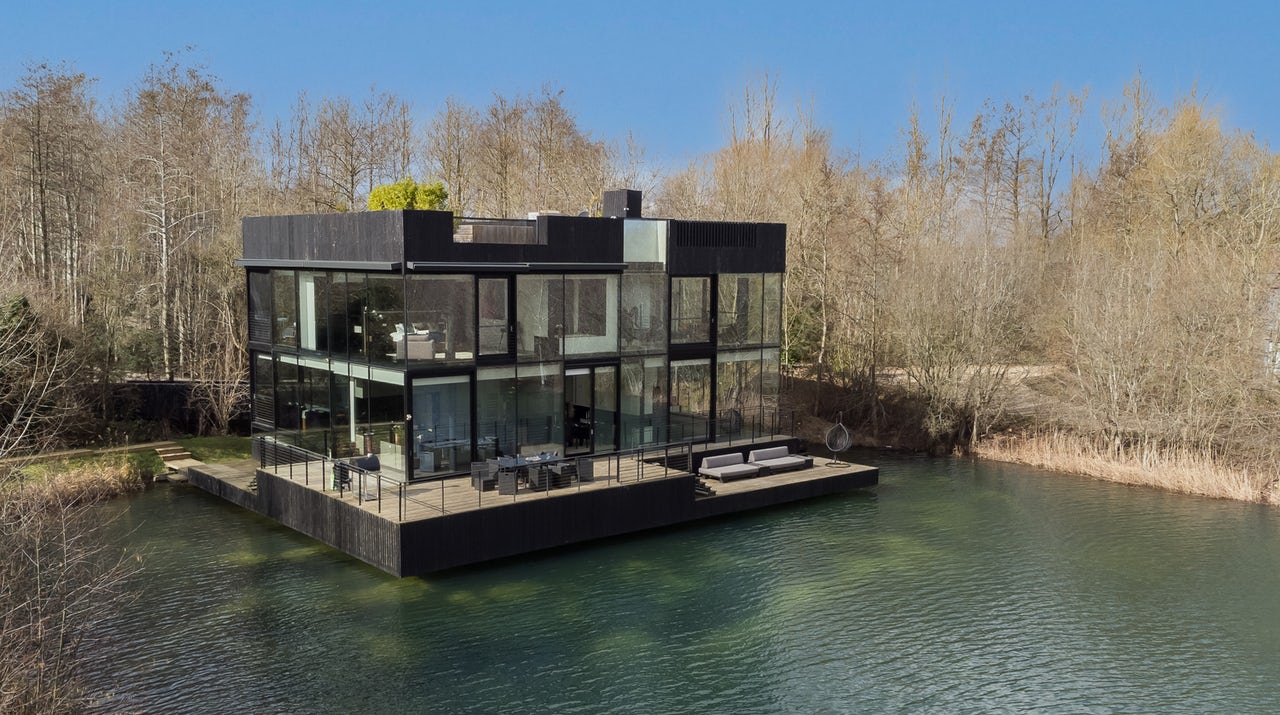
A house that floats is a strange idea until you stand in one. Then it becomes something else: a slow, lucid reorientation of how a home should relate to the ground it occupies, to the water it doesn't displace, to the light it invites. The Glass House by the Lake - set on Huntsman Lake within the private Lakes by Yoo estate in Lechlade, Gloucestershire - was designed to make that reorientation happen the moment you cross the bridge.
Across a recent four-hour visit in early spring, the lake shifted through perhaps six distinct readings: a flat morning mirror, a wind-chopped silver, a sky-echoing grey, a last hour of amber. The house watched all of it, uninterrupted. That is what it was built to do.
A Dutch studio, a British lake
The Glass House - formally titled Glass Villa on the Lake by its architects - was designed by Mecanoo, the Delft-based practice founded in 1984 by Francine Houben. Houben is one of the most decorated architects working today: an honorary fellow of the Royal Institute of British Architects, the American Institute of Architects, and the Royal Architectural Institute of Canada; named Architects' Journal Woman Architect of the Year in 2014; holder of honorary doctorates from Utrecht University and Belgium's Universite de Mons. Her practice's best-known work in Britain is the Library of Birmingham, RIBA National Award winner and Stirling Prize shortlisted in 2014.
The partner architect for the Glass Villa was Dick van Gameren, a Mecanoo partner since 2013 and current Dean of the Faculty of Architecture at TU Delft. His earlier work on the Dutch Embassy in Addis Ababa won the 2007 Aga Khan Award for Architecture. For a private four-bedroom villa on a British lake, the architectural provenance is unusual - closer to the pedigree of a civic building than a holiday home.
That was the point. When the owner approached Mecanoo in the mid-2010s, the brief was philosophical before it was practical: a house that would dissolve into water, trees, and sky rather than impose itself upon them. The owner told the BBC series World's Most Secret Homes in 2019:
The inspiration for the glass house goes back maybe 30 plus years. I was a young man watching a movie and there was a glass house in there on the sea and I was fascinated. I always had this dream to one day build a glass house. I wanted to live outside. I wanted to see water. I wanted to hear nature. The Owner - BBC World's Most Secret Homes, 2019
Mecanoo's stated design principle was, in their own words, to create a house that combines transparency with sustainability, forging a strong relationship between the villa and the landscape. The result, completed in 2018 after two years of design and two of construction, was a three-storey glass residence extending from a semi-submerged basement 3.5 metres below the lake surface up through a living level and onto an elevated roof terrace with views of three lakes.
It was named winner of The Plan Award 2019 in the Villa category and took Silver at the London Design Awards 2019 in residential.
What you see, what you don't
Seen from the approach, the house is a surprisingly restrained object. The timber cladding - Shou Sugi Ban, the ancient Japanese technique of charring cedar to produce a finish that is simultaneously fire-resistant, weatherproof, and chemically inert - reads almost black at first glance. The glass is so clear, so floor-to-ceiling, that it disappears into whatever the lake is doing that hour. A bridge set diagonally to the access road - carefully angled so that it doesn't disturb the existing plant life, as Wallpaper* described it - delivers you across without fanfare.
Only inside does the scale assert itself. Every room has two glass walls, each a minimum of six metres across. Ceiling heights range from 2.8 to 3.5 metres throughout the house. The central atrium rises the full height of the building, drawing daylight down to the sunken basement and drawing the eye up to the glass-roofed peak. A staircase - carved from a single 500-year-old tree imported from Slovenia - threads the levels together.
The interior material palette is deliberately narrow: Negro Marquina and Carrara marble, dark wood flooring, metal balustrades, white walls. Nothing competes with what's outside. As Luxuria Lifestyle put it in 2021: the only really important canvas is Mother Nature.
Furniture is by Poliform and Cassina - the sofas, the Cab leather dining chairs. Lighting is drawn from Bocci, Tom Dixon, Davide Groppi and Philippe Starck. The kitchen is Varenna, fitted with professional Gaggenau appliances including a tandoori oven, pizza oven, steam oven, and integrated wine fridge.
The engineering was more demanding than the architecture suggests. To build a habitable basement 3.5 metres below the waterline of an active lake, sixty-five steel columns were driven into the gravel bed. A four-metre excavation was made. Reinforced concrete walls were fabricated off-site and lowered into place. The glass panels themselves - at seven centimetres thick, triple-glazed - weigh thousands of kilograms each.
The sustainability specification reflects the same design intent. Thirty-two solar panels supply approximately 80% of the home's electricity. An air thermal heat pump handles heating. A mechanical ventilation with heat recovery (MVHR) system manages indoor air quality. The triple glazing holds the thermal envelope tight. Low energy consumption, as Mecanoo described it, by architectural design.
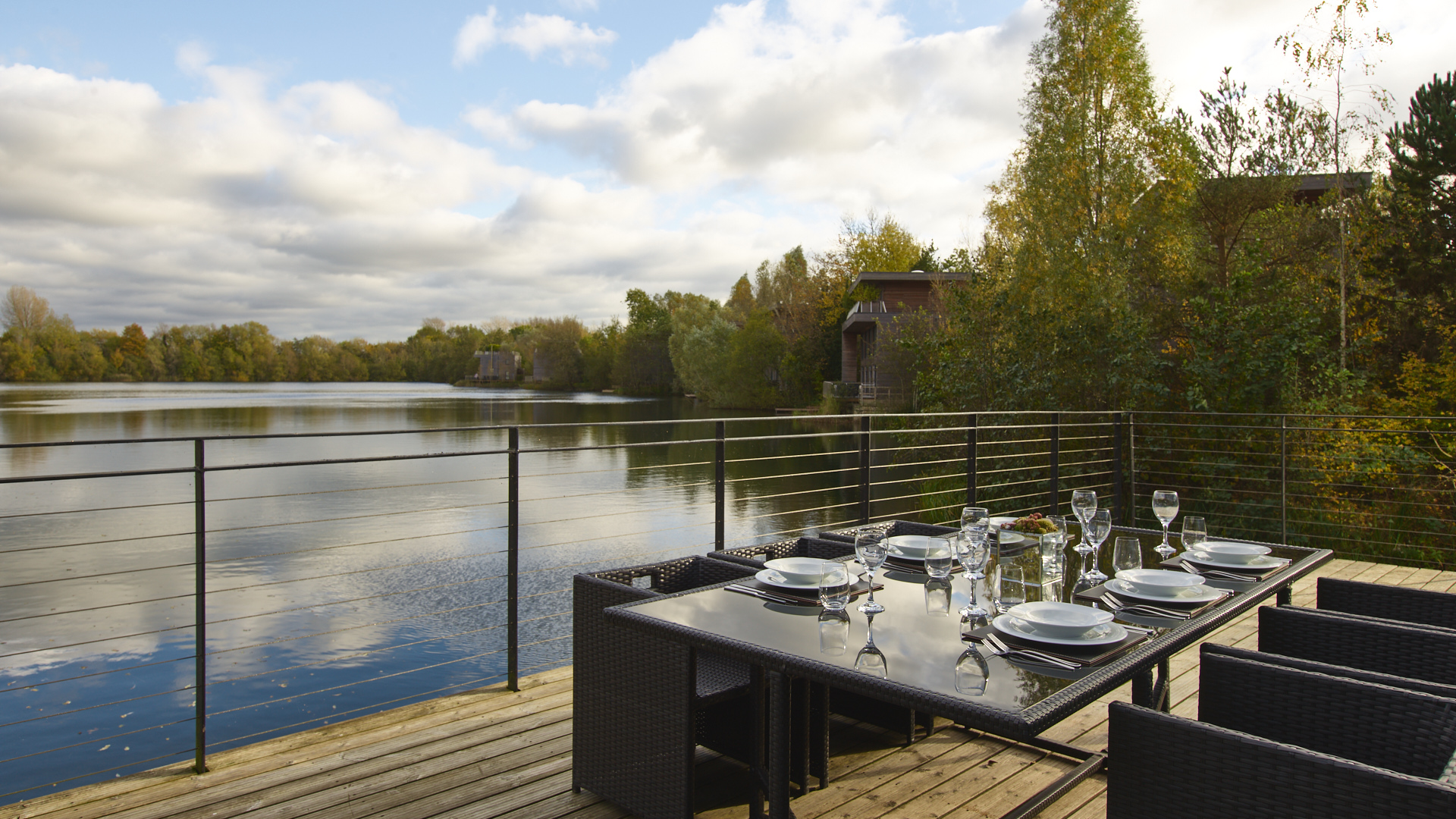
The bridge delivers you across the water without fanfare. The house asserts itself only from the inside.
Five hundred and sixty square metres of specific rooms
The house is not a continuous flowing volume; it is divided, quietly, into rooms that do different things. 561.8 square metres of internal space (6,047 square feet), three storeys, a rooftop terrace, and a central void that threads daylight from the glass roof down to the lake-level floor below.
The ground floor is the arrival and gathering level. Two reception rooms sit either side of an open Varenna kitchen, with a single bedroom suite tucked into the ground-floor corner. A balcony wraps the building on the lake side; a private garden of roughly 288 square metres (32 by 9 metres) extends the ground plane outward toward the water. This is where the lake makes its most direct appearance - on still days, the floor-to-ceiling glass gives way to nothing but water, sky, and the occasional flock of geese tracing a line across the reflection.
The first floor holds three further bedrooms, each en-suite, each with its own outlook across the lake or the wooded estate beyond. A reception room on this level opens toward the void: the central atrium that drops through the house, glazed at the roof, cutting three storeys of daylight down to the lower ground floor. Marble bathrooms. King and super-king beds.
The lower ground floor, 3.5 metres below water level, is where the house does something few others do. Because the glazing at this level sits at lake height, light pours in horizontally through the water during the day. The result is a subterranean floor that doesn't feel subterranean. It is divided into distinct rooms rather than one multipurpose basement: a nine-seat Cinema Room with professional projection; a Play Room with full-size snooker table and fully themed bar; a Leisure Room; a wellness area with a Harvia sauna and indoor hot tub. Plant room and utility room are tucked behind service walls.
Above it all, the roof terrace - approximately 134 square metres (13.5 by 9.9 metres) of elevated platform with panoramic views across Huntsman Lake and two neighbouring lakes, accessed via an electrically operated skylight. The roof is where the spatial logic of the house resolves: you have been below the water, at the water, and now above it, and the lake has shown you three different selves along the way.
The estate
The Glass House does not sit in isolation. It is part of The Lakes by Yoo, a roughly 850-acre private estate founded in 2000 by designer Philippe Starck and property developer John Hitchcox. Speaking to British Travel Journal in 2024, Hitchcox described the estate's origins: I was a total urbanite, but I wanted the kids to be brought up in the country - somewhere they could play outside, explore woodland, go sailing and more.
What he built instead of a family retreat was a community. The estate now comprises around ninety private residences positioned around six spring-fed lakes, most designed or commissioned through YOO's stable of named designers - Jade Jagger, Kelly Hoppen, and others. A members' spa with a seventeen-metre heated pool, sauna, steam room, and treatment rooms. A lakeside tipi restaurant. Zip lines, paddle boards, horse riding, a farm with beehives producing honey for residents, an art park with sculptures commissioned from international artists including Yoshitomo Nara and KAWS.
In 2026, Junior Magazine named The Lakes by Yoo Best Eco Family Resort in the UK. In 2024, The Times described it as the epicentre of the Cotswolds celebrity scene - a gentle exaggeration, but a revealing one.
Rental rates across the estate typically range between £12,000 and £40,000 per week, with the most architecturally distinctive properties commanding the upper end. The Glass House sits at the most distinctive end of that range, with nightly rates from £1,650 and a peak-season weekly rate that reflects the rarity of what it offers.
The Cotswolds as a category
What the Glass House has become, almost inadvertently, is the clearest example of a specific category of British luxury property that barely existed fifteen years ago and is now reshaping the entire market: the design-led Cotswolds retreat.
The data supports the claim. Savills' Prime Cotswolds Market Report, published in March 2026, found that international buyers now account for just over 21% of sales above £1.5 million in the region - and that North American buyers specifically now represent 13% of prime sales in 2025, against a long-term average of just 3.5%. That's a near-quadrupling of American demand for Cotswolds prime property in a single year. Speaking on the report, Savills director Plum Fenton described a market where buyers prioritising architectural integrity, sympathetic restoration, privacy, and connectivity are driving selective but committed demand at the top of the market.
The trend has a name already. Business Insider ran the headline American Money Is Turning the Cotswolds Into the Hamptons of England in November 2025. The Telegraph ran a companion piece on the invasion. The Times reported that ultra-premium Cotswolds rentals reach £50,000 per week at the peak - the kind of figure that once belonged only to south-of-France summers.
On the rental side, the numbers are equally striking. AirROI data for the Cotswolds District over the year to March 2026 shows average nightly rates of approximately £315, with the top 10% of properties commanding over £628. Year-on-year revenue per listing grew 13.8%. The category is not just expanding - it is professionalising.
And the consumer thesis underneath is clear: according to Preferred Hotels and Resorts' Luxury Travel Report 2025, 72% of luxury travellers say they would not pay to stay somewhere that looks like everywhere else. The traditional rural cottage - however Cotswold-stone picturesque - no longer signals premium; it signals interchangeable. What signals premium is architectural specificity. A house you have not seen before.
Not a cabin. Not a dome. A house.
The category is attracting new entrants. A wave of design-forward, purpose-built retreats has been announced or launched in the Cotswolds and adjacent counties over the past two years - mirrored woodland cabins, geodesic domes, architect-commissioned treehouses at Cornbury Park, woodland cabins at Estelle Manor. A £24 million new resort was announced for the region in early 2026.
The Glass House stands apart within this wave for a simple reason: it is a house, not an accommodation format. Four bedrooms, four en-suite bathrooms plus two additional WCs, over 560 square metres of considered architectural space designed for an extended private stay rather than a glamping weekend. It is the closest thing Britain has to the kind of architect-authored residential rental you find at the very top of the market in the Hamptons, in Provence, on the Amalfi coast. It is not trying to be a novel sleeping format. It is a proper home - that happens to float.
That distinction matters, and it is why the Glass House has attracted the specific guests it has. The property has hosted private stays of the highest discretion, including extended stays for distinguished international guests whose identities remain protected by non-disclosure. It has served as a filming location for BBC One's Showtrial (2021) and was the subject of its own 44-minute BBC episode of World's Most Secret Homes in 2019. It has hosted brand activations for Lamborghini, fashion editorial shoots, and private celebrations that prefer not to advertise themselves.
The house's discretion is part of its product.
Who it's for
The Glass House works best for guests who want three things simultaneously: the privacy of a proper country estate, the aesthetic register of an architect-designed residence, and the practical security of the managed estate around it.
In practice, that describes several kinds of stay. A family group or extended household taking the full house for a season of Christmas or summer, where the design ambition of the property is part of why the stay is memorable rather than merely comfortable. A couple or small group seeking a purpose-built retreat that matches their own life's aesthetic - people for whom nice rental is not quite the point, but stay in a Mecanoo-designed house on a private lake is. A private event at a scale the house can hold: an intimate wedding weekend, a creative retreat, a launch, a milestone. A brand, production, or editorial team for whom the house's architectural distinction, managed privacy, and 90-minute proximity to London make it viable as a working location rather than just a venue.
What it is not: a glamping stay, a novelty booking, or a short weekend drop-in. Minimum stays apply, rates are substantive, and the property rewards guests who take time to let the lake do what it does across a few days rather than a few hours.
Getting there
The Glass House is approximately 90 minutes by car from central London via the M4 and A419. The nearest mainline station is Swindon, served by Great Western Railway from London Paddington in around an hour; taxis from Swindon to the estate take approximately 30 minutes. Bristol, Bath, and Oxford are all within an hour's drive. Cirencester and Lechlade are close for dining, shopping, and the full Cotswolds village-and-pub circuit.
The Lakes by Yoo estate is gated and 24-hour managed. All guest access is pre-arranged through the estate's own security and concierge operation, working in coordination with the property's management team at Super Prime International.
Epilogue
The Cotswolds is changing. The money coming in is international, the taste is getting sharper, and the category of property that once defined the region - the stone cottage with beams and an Aga - is slowly, inexorably ceding ground to a different kind of house altogether. Architect-authored. Contemporary. Sometimes floating.
The Glass House was one of the earliest and remains the most distinctive example. It is not the first. It will not be the last. But eight years after completion, it still does something none of the newer entrants quite manage: it disappears.
Stand inside, on a clear April morning, and the house is all but gone. The lake is closer than it has any business being. The swans are making their three-part morning transit across Huntsman. The light is reaching in and finding the Slovenian staircase and falling onto pale marble and pooling on dark wood, and for a long minute - longer than feels reasonable - you forget there's a building around you at all.
That is what the architects designed the house to do. And that is what the guests come back for.